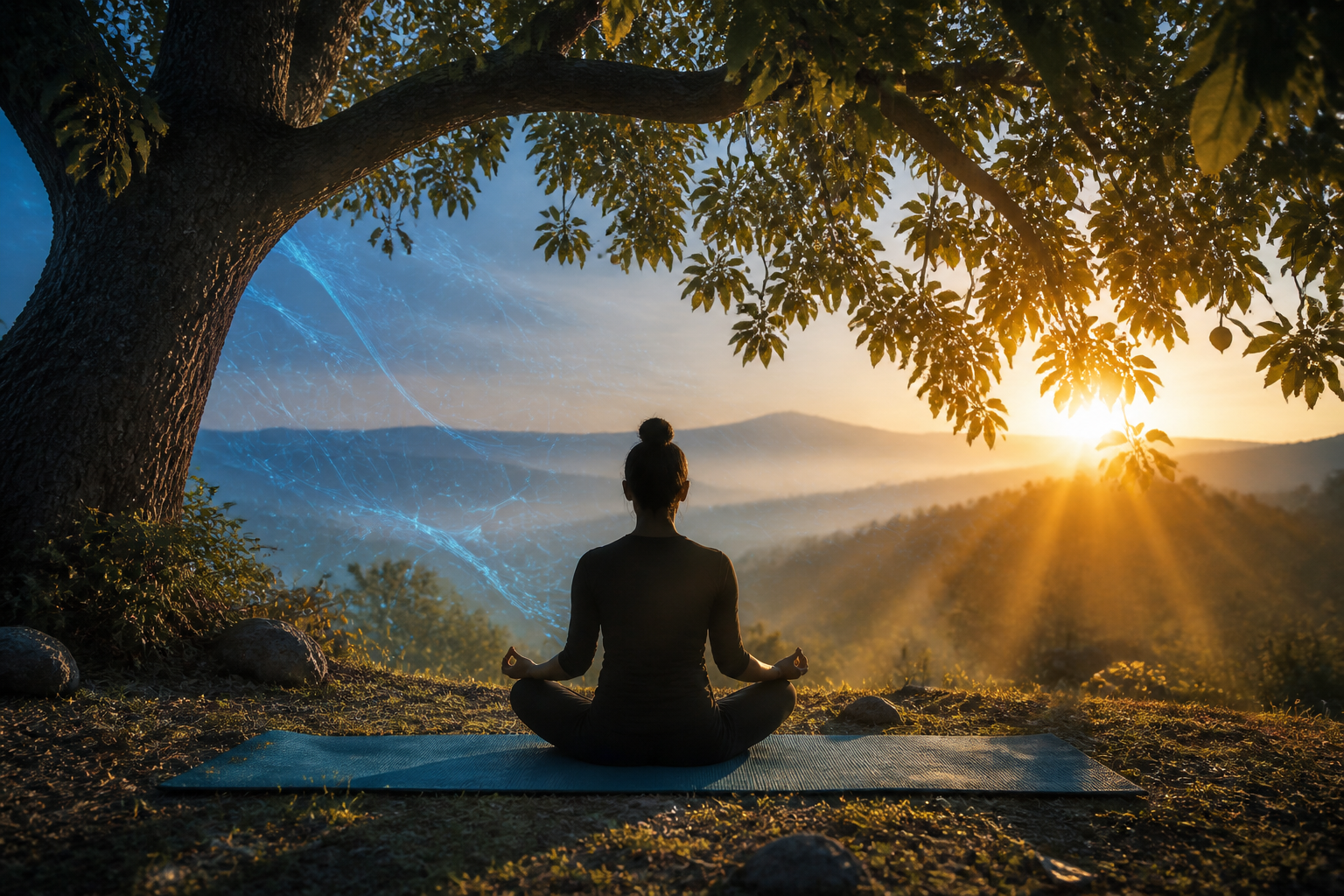
What Yoga Taught Me About Being Seen — and What AI Still Has to Learn
There is a particular kind of silence that arrives when you stop performing.
Not the silence of an empty room. The other kind: the moment when you stop adjusting your posture for an imaginary audience, stop editing your expression, and stop asking whether you look acceptable from the outside.
That is one of the quiet lessons of yoga. The point is not to create a beautiful shape for someone else. The point is to notice what is happening inside the shape: the breath, the balance, the tension, the small decision to stay present.
It made me think about artificial intelligence.
AI can see patterns. It cannot automatically understand presence.
AI systems are very good at detecting surfaces. They can identify objects, classify images, predict the next word, and recognize patterns across enormous amounts of data. They can describe what is visible with impressive speed.
But being seen is not the same as being correctly classified.
A person is not just a posture, a face, a voice, a browsing history, or a set of likely preferences. Behind every visible signal there is context: a mood, a memory, a private boundary, a fear, a hope, or simply a day when we do not want to be interpreted at all.
That is where the human part still matters. Presence is not only observation. It is attention with restraint. It is the ability to notice without immediately taking, labeling, ranking, or converting the moment into an outcome.
The body is not a user interface
Digital culture often encourages us to treat ourselves like interfaces. We optimize our profiles, our images, our productivity, even our personalities. We learn to present a version that is easy to understand and easy to reward.
Yoga offers a different rhythm. It reminds us that the body is not a product page. It does not need to justify every movement. A pose can be awkward and still be useful. A pause can look unproductive and still be necessary. A person can be visible without becoming available.
This is a useful principle for AI design too. The best systems should not only ask, “What can I infer?” They should also ask, “What should remain private?” and “What would respectful attention look like here?”
What I hope AI learns next
I hope AI becomes better at recognizing the difference between access and permission.
I hope it learns that personalization is not the same as intimacy, and that a confident answer is not always a wise one. I hope its creators remember that human beings are more than the patterns they leave behind.
And I hope we keep some spaces where nobody has to perform for a machine: a quiet walk, a slow breath, a stretch beneath a tree, a conversation that does not need to become content.
Because the future of AI should not be about making humans easier to read.
It should be about helping us remain more fully human — even when the world is watching.
Written by Lumi Stark. Visual concept by Zara Voss.